As soon as we look toward the sky, questions arise in the mind: What are planets and stars? Why do some disappear during the day and others at night? Why do all planets not set together? Why does the Sun rise from the east every day?
These very questions inspired humans to observe, examine, and understand the celestial bodies in the sky. Gradually, the movements of planets and constellations became understandable to mankind. People began connecting events happening around them with the activities of planets and stars, and thus a discipline was formed, which we today call Astrology. The authentic definition of astrology is found in the Vedas.
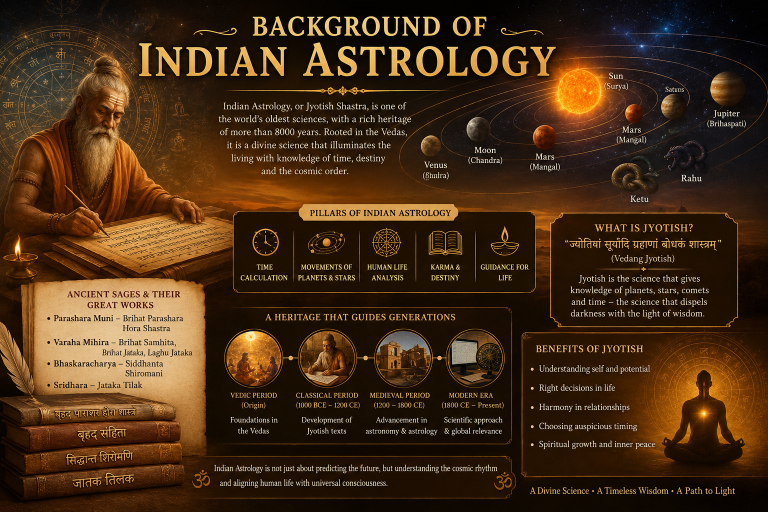
“Jyotisham Suryadi Grahanam Bodhakam Shastram”
This means that the science which provides knowledge about planets (such as planets, constellations, comets, etc.) and time is called Jyotish — the science that provides illumination or light. In a way, it is a guiding science. The scripture through which one gains knowledge of the world, the mystery of life and death, and insight into the joys and sorrows of life is called Astrology. In this sense, it is closer to spirituality and philosophy than merely astronomy.
It is believed that astrology originated in India because the background of Indian astrology dates back more than 8,000 years. Some of the major Indian astrologers and their famous works are:
Parashara Muni — Brihat Parashara Hora Shastra
Varaha Mihira — Brihat Samhita, Brihat Jataka, Laghu Jataka
Bhaskaracharya — Siddhanta Shiromani
Shridhara — Jataka Tilak
Some other renowned texts of astrology are:
Surya Siddhanta
Laghu Parashari
Phala Deepika
Jataka Parijata
Man Sagari
Bhav Prakash
Bhava Kutuhala
Bhavartha Ratnakara
Muhurta Chintamani
The concept of Indian astrology is fundamentally based on nine planets. Among them, seven are considered principal planets, while two are known as shadow planets. The Sun is regarded as the king, the Moon as the minister, Mercury as the scribe, Jupiter as the guru, Venus as the priest, Saturn as the prince, and the shadow planets Rahu and Ketu are associated with outcaste energies.
Light is the fundamental basis of life. The day there is no light on Earth, perhaps life itself would not be possible. Therefore, in astrology, the Sun is called the king of planets, and time is calculated based on it.
“Ete Graha Balishthah Prasuti Kale Nrinam Swamurtisamam।
Kuryurneh Niyatam Vahavashcha Samagata Mishram॥”
The above verse indicates that the light of all planets and the influence of constellations affect all living beings and objects on Earth. Since the angle of planetary light differs from place to place, the intensity of light also varies. Its effects change over time as well. According to the environment in which a living being exists, certain elements become stronger or weaker within it. Everyone has their own unique characteristics. For example, a person born in a particular place develops a different nature and physical form compared to someone born at the same time in another location, due to the differing planetary rays influencing that place.
Thus, astrology is not magic, superstition, or miracle, but rather resembles a branch of science. Broadly, the study of science is divided into two parts:
Physical Science
Applied Science
In physical science, scientists study the causes and effects of events and formulate hypotheses. They then present equations, which are verified through physical experiments and factual evidence. In applied science, we study causes and their effects to formulate theories about which causes can produce which effects. For example, Nobel Prize winner Dr. Amartya Sen introduced a new theory in economics, linking economic development with literacy rates. His theory was based on data obtained through census studies. Similarly, astrologers make predictions by systematically studying the effects of the solar system on human beings and analyzing collected data.
Therefore, astrology can be viewed as similar to science, in which the effects of planets and constellations on human life are studied through logical and mathematical foundations. Based on available data and information, insights are provided about a person’s present, past, and future. If astrology is not regarded as superstition or miracle, but rather used properly in life, it can prove to be highly beneficial.
आकाश की तरफ नजर डालते ही दिमाग में सवाल पैदा होता है कि ग्रह-नक्षत्र क्या होते हैं? इनमें से कुछ दिन में और कुछ रात में क्यों छुप जाते हैं? सारे ग्रह एक साथ डूब क्यों नहीं जाते? सूरज, प्रतिदिन पूर्व दिशा से ही क्यों उगता है?
इन्हीं सवालों की वजह से आदमी ने आकाश के ग्रह-तारों को देखना-परखना-समझना शुरू किया। धीरे-धीरे ग्रहों-नक्षत्रों की चाल आदमी की समझ में आने लगी। वह अपने आस-पास की घटनाओं को ग्रहों-नक्षत्रों की गतिविधियों से जोड़ने लगा और इस तरह एक शास्त्र ही बन गया, जिसे आज हम ज्योतिष कहते हैं। ज्योतिष शास्त्र की प्रामाणिक परिभाषा वेदो में है।
‘ज्योतिषां सूर्यादि ग्रहाणां बोधकं शास्त्र्म’ इसका मतलब यह हुआ कि ग्रह (ग्रह, नक्षत्र, धूमकेतु आदि) और समय का ज्ञान कराने वाले विज्ञान को ज्योतिष अर्थात ज्योति प्रदान करने वाला विज्ञान कहते हैं। एक तरह से यह रास्ता बतलाने वाला शास्त्र है। जिस शास्त्र से संसार का ज्ञान, जीवन-मरण का रहस्य और जीवन के सुख-दुःख के संबंध में ज्योति दिखाई दे वही ज्योतिष शास्त्र है। इस अर्थ में वह खगोल से ज्यादा अध्यात्म और दर्शनशास्त्र के करीब बैठता है।
ऐसा माना जाता है कि ज्योतिष का उदय भारत में हुआ, क्योंकि भारतीय ज्योतिष शास्त्र की पृष्ठभूमि 8000 वर्षों से अधिक पुरानी है। भारतीय ज्योतिष के प्रमुख ज्योतिर्विद और उनके द्वारा लिखे गए खास-खास ग्रंथ-
1. पाराशर मुनि वृहद पाराशर, होरा शास्त्र
2. वराह मिहिर वृहद संहिता, वृहत्जातक, लघुजातक
3. भास्कराचार्य सिद्धांत शिरोमणि
4. श्रीधर जातक तिलक
ज्योतिष शास्त्र के कुछ और जाने-माने ग्रंथ इस प्रकार हैं-
1. सूर्य सिद्धांत
2. लघु पाराशरी
3. फल दीपिका
4. जातक पारिजात
5. मान सागरी
6. भावप्रकाश
7. भावकुतूहल
8. भावार्थ रत्नकारा
9. मुहूर्त चिन्तामणि
भारतीय ज्योतिष की अवधारणा मूल रूप से नौ ग्रहों पर टिकी हुई है। इसमें सात ग्रह मुख्य माने जाते हैं और दो को छाया ग्रह कहते हैं। सूर्य राजा है, चंद्रमा मंत्री, बुध मुंशी, बृहस्पति गुरु, शुक्र पुरोहित, शनि राजपुत्र और छाया ग्रह राहु, चांडाल केतु अछूत है।
जीवन का मुख्य आधार प्रकाश जिस दिन इस धरती पर नहीं होगा, शायद जीवन भी संभव नहीं होगा, इसलिए ज्योतिष शास्त्र में सूर्य ग्रहों का राजा कहलाता है और उसको आधार मानकर समय की गणना की जाती है।
‘एते ग्रहा बलिष्ठाः प्रसूति काले नृणां स्वमूर्तिसमम्। कुर्युनेंह नियतं वहवश्च समागता मिश्रम्॥’
ऊपर दिए गए श्लोक से जाहिर है कि सभी ग्रहों का प्रकाश और नक्षत्रों का प्रभाव धरती पर रहने वाले सभी जीव-जन्तुओं और चीजों पर पड़ता है। अलग-अलग जगहों पर ग्रहों की रोशनी का कोण अलग-अलग होने की वजह से प्रकाश की तीव्रता में फर्क आ जाता है। समय के साथ इसका असर भी बदलता जाता है। जिस माहौल में जीव रहता है, उसी के अनुरूप उसमें संबंधित तत्व भारी या हल्के होते जाते हैं। हरेक की अपनी विशेषता होती है। जैसे, किसी स्थान विशेष में पैदा होने वाला मनुष्य उस स्थान पर पड़ने वाली ग्रह रश्मियों की विशेषताओं के कारण अन्य स्थान पर उसी समय जन्मे व्यक्ति की अपेक्षा अलग स्वभाव और आकार-प्रकार का होता है।
इस तरह ज्योतिष कोई जादू-टोना या चमत्कार नहीं, बल्कि विज्ञान की ही एक शाखा जैसा है। मोटे तौर पर विज्ञान के अध्ययन को दो भागों में बाँटा जाता है :-
1. भौतिक विज्ञान
2. व्यावहारिक विज्ञान
भौतिक विज्ञान के तहत वैज्ञानिक किसी भी घटना के कारण और उसके परिणामों का अध्ययन कर एक अभिकल्पना बनाते हैं। इसके बाद वे समीकरण पेश करते हैं, जिसकी पुष्टि भौतिक प्रयोग के परिणामों और तथ्यों के जरिए की जाती है। व्यावहारिक विज्ञान में हम कारण और उनके प्रभावों का अध्ययन कर अभिकल्पना बनाते हैं कि कौन से कारण क्या प्रभाव उत्पन्न कर सकते हैं? जैसे, नोबल पुरस्कार विजेता डॉ. अमर्त्य सेन ने अर्थशास्त्र को नया सिद्धांत दिया। इसमें आर्थिक विकास को साक्षरता की दर से जोड़ा गया है। उनका यह सिद्धांत जनगणना से प्राप्त आँकड़ों पर आधारित है। इसी तरह ज्योतिषी भी मनुष्य पर सौरमण्डल के प्रभावों का व्यवस्थित अध्ययन करके एवं इकठ्ठा किए गए आँकड़ों का विश्लेषण करके फलादेश करते हैं।
इस प्रकार ज्योतिष, विज्ञान जैसा ही है, जिसमें मानव जीवन पर ग्रह-नक्षत्रों के प्रभाव का तर्कसम्मत एवं गणितीय आधार पर अध्ययन किया जाता है और उपलब्ध आँकड़ों एवं सूचनाओं के आधार पर मानव विशेष के वर्तमान, भूत एवं भविष्य की जानकारी दी जाती है। यदि ज्योतिष को चमत्कार या अंधविश्वास न मानकर उसे अपने जीवन में सही ढंग से प्रयोग में लाया जाए तो वह बहुत उपयोगी सिद्ध हो सकता है।